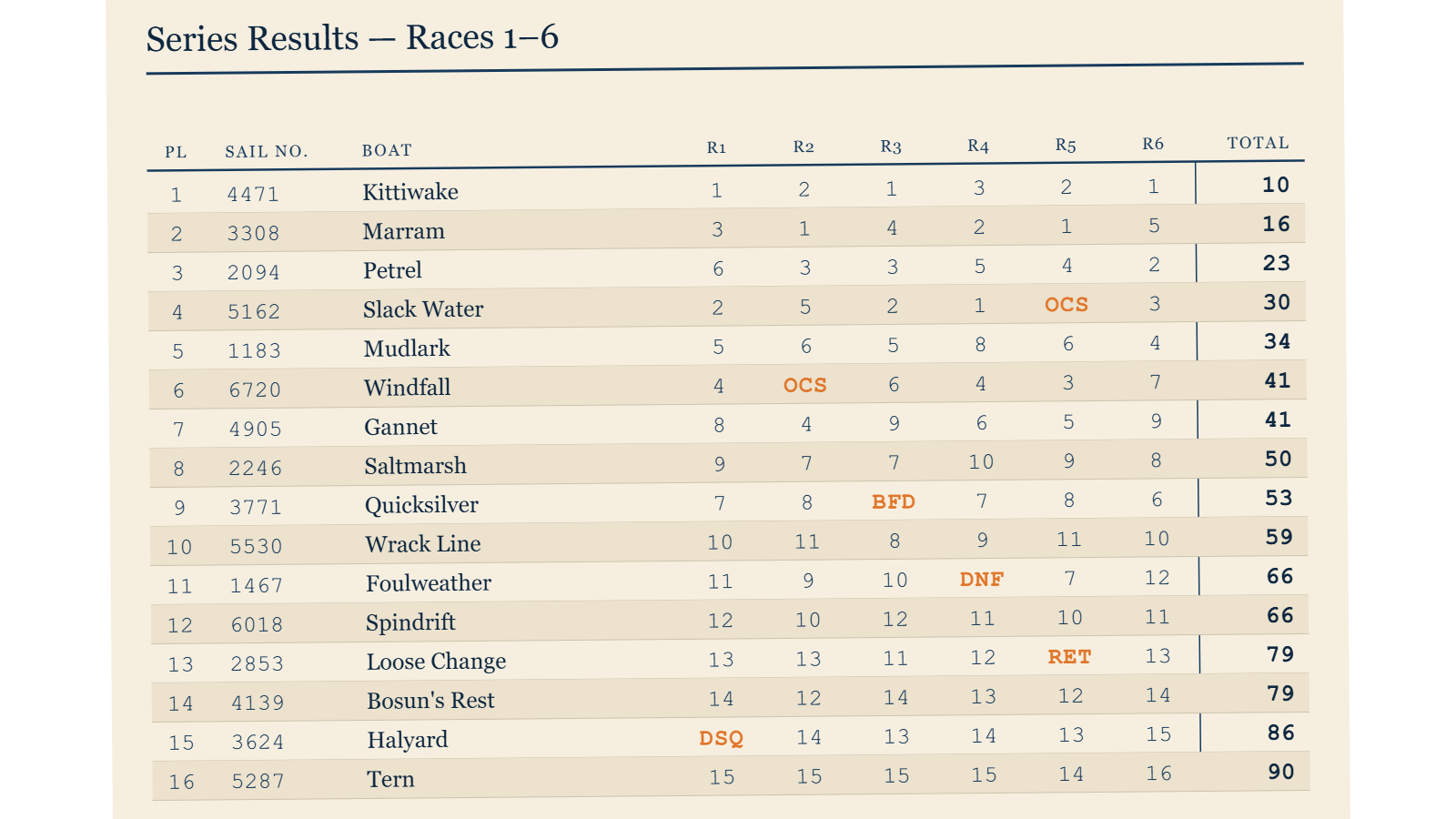
You cross the finish line, head to the results board, and instead of a time or a place next to your sail number you see three letters: OCS, BFD, or DNF. If you have ever stared at a results sheet wondering what you actually did wrong, you are not alone — these codes look like alphabet soup until you know what each one means and which rule sits behind it.
There are fourteen of them and they all come from rule A10 of The Racing Rules of Sailing 2025 – 2028, published by World Sailing. The rules that produce them are spread across the book – rule 30 for the starting penalties, rule 44 for penalties you take yourself, rules 60 and 64 for what a protest committee does and Appendix A for how it all lands on your series score. Here is the whole set.
The Fourteen Codes
Rule A10, Scoring Abbreviations
| code | what it records |
|---|---|
| DNC | Did not start – never came to the starting area. |
| DNS | Did not start, for a reason other than DNC or OCS. |
| OCS | Did not start – on the course side of the starting line at the starting signal and failed to start or broke rule 30.1. |
| ZFP | 20% penalty under rule 30.2 (Z flag). |
| UFD | Disqualification under rule 30.3 (U flag). |
| BFD | Disqualification under rule 30.4 (black flag). |
| SCP | Scoring Penalty Imposed. |
| NSC | Did not sail the course. |
| DNF | Did not finish. |
| RET | Retired. |
| DSQ | Disqualification. |
| DNE | A disqualification that is not excludable under rule 90.3(b). |
| RDG | Redress given. |
| DPI | Discretionary penalty imposed. |
what the letters stand for
The rulebook never says. Rule A10 gives you the code and the circumstance it records and nothing else. Expansions like “Did Not Compete” or “On Course Side” are sailors’ shorthand, useful for remembering them but not official. When it matters, go by the circumstance, not the initials.
When You Never Really Started
DNC – Covers the simplest case: you did not come to the starting area at all.
DNS – Covers everything else that kept you from starting, other than DNC and OCS – gear failure, missed sequence, a decision made ashore.
OCS – The one every racer dreads at the gun. Rule A10 defines it as a boat that was on the course side of the starting line at the starting signal and failed to start, or broke rule 30.1.
- Rule 30.1 is the I flag rule: if flag I has been displayed and any part of a boat’s hull is on the course side of the line or one of its extensions during the last minute before your starting signal, you must sail across an extension so that the hull is completely on the pre-start side before you start.
The Three Starting-Penalty Flags
Rule 26 allows six things to fly as the preparatory signal: P, I, Z, Z with I, U, or the black flag. Three of those — Z, U and black — police the same piece of water in the same way. During the last minute before your starting signal, no part of your hull may be in the triangle formed by the ends of the starting line and the first mark. What differs is the price, and how long it follows you.
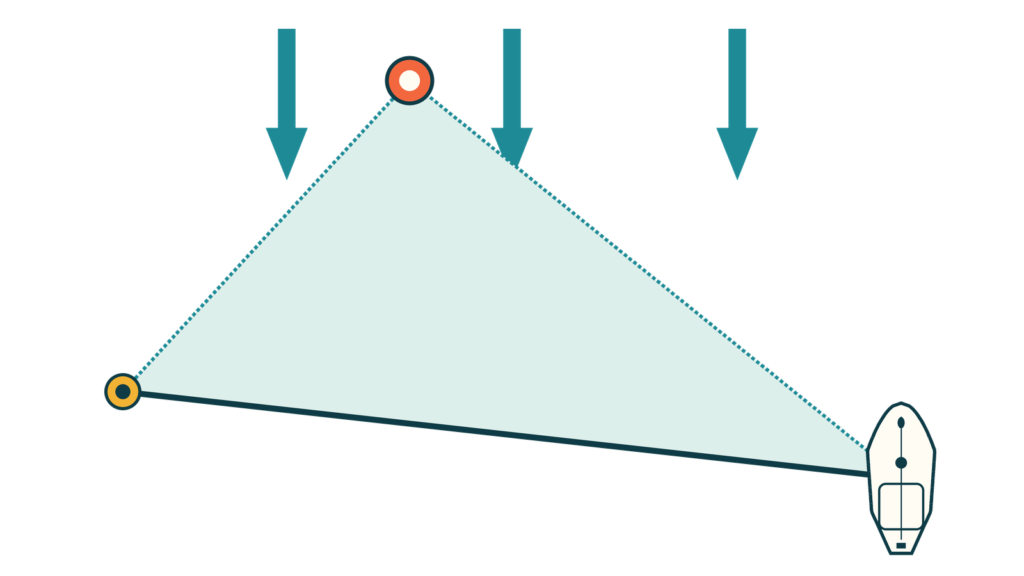
ZFP – Z Flag Penalty (rule 30.2)
When the Z flag is flying, no part of your hull may be in the triangle formed by the ends of the starting line and the first mark. When broken, receive a 20% scoring penalty without a hearing, calculated as stated in rule 44.3(c). The penalty stands even if the race is restarted or resailed – though not if the race is postponed or abandoned before the starting signal. Get identified again during a later attempt to start the same race and you collect an additional 20%.
UFD – U Flag Disqualification (rule 30.3)
Same triangle, same last minute restriction, but under U flag the penalty jumps straight to disqualification without a hearing. The one piece of mercy: if the race is restarted or resailed, the penalty doesn’t apply.
BFD – Black Flag Disqualification (rule 30.4)
The harshest of the three. Under a black flag, being in that triangle during the last minute means disqualification without a hearing — and unlike the U flag, this one survives a restart or resail, though not a postponement or abandonment before the starting signal. If a general recall is signaled, or the race is abandoned after the starting signal, the race committee displays your sail number before the next warning signal for that race, and you are not to sail in the restart. Sail in it anyway and your disqualification will not be excluded when your series score is calculated.
The three-flag test
Z, U, and black flags all police the same triangle in the same final minute. What separates them is what survives a restart and the penalties they carry. Z carries over and stacks. U doesn’t carry over. Black flag carries over and bars you from the restart.
Codes for Boats that Started but Didn’t Finish
RET – Records a retirement, you started, then pulled out. Retiring is sometimes not a choice: under rule 44.1(b), if you caused injury or serious damage, or gained a significant advantage in the race or series, your penalty is to retire.
DNF – Did not finish. A boat that started but didn’t finish.
NSC – Did not sail the course, other than DNC, DNS, OCS and DNF. Rule 28.1 requires a boat to sail the course; rule 28.2 lets you correct errors in doing so, provided you haven’t finished. If not corrected NSC is recorded.
Disqualification and Penalty Codes
DSQ – General disqualification that normally follows a protest hearing. Rule 60.5 sets out what happens: the protest committee conducts a hearing as rule 63 requires, and if it decides a boat broke a rule, it shall disqualify it — whether or not that particular rule was mentioned in the protest. Rule 63.5 describes how the decision is reached: the committee weighs the evidence, finds the facts on the balance of probabilities unless a rule requires otherwise, then applies the rules to those facts.
There are exceptions worth knowing. A boat is not disqualified if it is exonerated, if some other penalty applies, or if it has already taken an applicable penalty — unless the penalty for the rule it broke is a disqualification that is not excludable.
DNE – A disqualification that is not excludable. Most series let you discard your worst score, rule 90.3(b) is the reason a DNE survives it — when a scoring system provides for excluding scores, any DNE is still included in the series total.
Two situations in this article produce one. Rule 2, Fair Sailing, states that its penalty shall be a disqualification that is not excludable. And under rule 30.4, a black-flagged boat that sails in a restart that was told to stay out keeps the disqualification in the series score.
SCP – Scoring Penalty Imposed. This is the organizer’s choice, not yours: under rule 44.1, when the notice of race or sailing instructions specify the Scoring Penalty, it replaces turns altogether.
- To take one, fly a yellow flag as soon as you reasonably can after the incident, keep it up until you finish, and at the finishing line point it out to the race committee and tell them which boat was involved.
- The cost, under rule 44.3(c): your score gets worse by the number of points the notice of race or sailing instructions state, or by 20% of the DNF score if they don’t say. Nobody else’s score changes, and the penalty can never leave you worse off than a DNF.
DPI – Discretionary Penalty Imposed. Some breaches carry a penalty that can be less than disqualification such as throwing trash overboard. Under rule 64, if you report within the protest time limit that you broke one of them, the protest committee sets the penalty itself and no hearing is needed.
When Correction Goes Your Way
RDG – Not a penalty. Redress is available under rule 61.4 when your score or place in a race or series has been made significantly worse through no fault of your own — by an improper action or omission of a committee or the organizing authority, by injury or physical damage caused by a boat that was breaking a Part 2 rule, or because you gave help under rule 1.1, among other grounds.
How it is scored is up to the protest committee, which must make as fair an arrangement as possible for every boat affected — whether or not they asked for redress. Rule A9 offers three examples: the average of your points in all the races in the series except the one in question, the average of your points in all the races before it, or points based on where you were in the race when the incident happened. Averages go to the nearest tenth of a point, with 0.05 rounded upward. Under rule A6.2, other boats’ scores do not change unless the committee decides otherwise.
What Each Code Costs
In the Low Point System of rule A4, your score is simply your finishing place: first is one point, second is two, and so on. The codes are what happens when there is no finishing place to use.
Rule A5.2 sets the default. A boat that did not sail the course, retired or was disqualified is scored points for the finishing place one more than the number of boats entered in the series — worse than last, regardless of where you actually were on the water.
ZFP and SCP are the exceptions. Rule A5.2 sends a boat penalized under rule 30.2, or one that takes a penalty under rule 44.3(a), to rule 44.3(c) instead. Your score is made worse by the penalty rather than replaced by it, and capped so it is never worse than a DNF.
check your sailing instructions for this one
If the notice of race or sailing instructions state that rule A5.3 applies, the math changes. A boat that came to the starting area but didn’t sail the course, retired or was disqualified is scored one more than the number of boats that came to the starting area – while a boat that never came to the starting area is still scored one more than the number entered in the series.
One knock-on effect that catches people out: under rule A6.1, when a boat is disqualified from a race, retires after finishing or is scored NSC, every boat with a worse finishing place moves up one place. Someone else’s bad day can improve your score without you doing anything.
Who Put the Code There
Not every code comes from a hearing, and knowing which is which tells you whether there was ever a process to take part in. Rule A5.1 lets the race committee score you without a hearing when it determines that you did not sail the course, did not comply with rule 30.2, 30.3, 30.4, 78.2, or retired or took a penalty under rule 44.3(a).
Beyond that list, only the protest committee may take scoring actions that make your score worse. Rule 60.5(b) puts the same limit from the other direction: a boat shall only be penalized at a protest hearing when the party, under rule 62.4, 64 or 69, or under a rule that expressly states a penalty may be applied without a hearing. If a code appeared next to your number and no hearing was held, rule A5.1 is the first place to look.
Codes that are Not on this List
Rule A10 says these abbreviations shall be used for recording the circumstances described — and the fourteen above are the complete set. You will occasionally see something else on a results sheet anyway. DSW is one that circulates in club and software contexts; it is not one of the fourteen. If a code turns up that is not in the table above, check your notice of race or sailing instructions, because it did not come from the rulebook.
The Bottom Line
Every one of these codes exists to answer one question for the race committee, the protest committee and every competitor: exactly what happened, and exactly how it affects the score. Once you know which rule sits behind each abbreviation, a results sheet stops looking like alphabet soup and starts reading like an account of what happened on the racecourse that day.
Current as of
The Racing Rules of Sailing 2025-2028, including changes and corrections made by World Sailing as of April 20, 2026. The Rules are revised every four years; this page is reviewed at each revision. Where an event’s notice of race or sailing instructions change a rule, those documents govern.
Source: World Sailing, The Racing Rules of Sailing 2025-2028 (PDF). Every rule cited here is taken from that edition. Where your reading and the rulebook differ, the rulebook wins.
What to read next
Race Signal Flags Explained
The I, Z, U and black flags that trigger OCS, ZFP, UFD and BFD, plus every other signal you’ll see from the committee boat.